• About us
    • Our Story
    • How we create impact
    • Why WASH matters
      • Health
      • Education
      • Employment and economy
      • Women & girls
      • Climate change
      • Environmental pollution
    • Our team
    • Accountability and financials
      • Governance
      • Financials
    • Contact us
  • Where we work
    • Bangladesh
    • Ghana
    • Kenya
    • Madagascar
    • Mozambique
    • Zambia
    • Uganda
  • Partner with us
  • Resources
    • Latest research
      • Innovative approaches to water & sanitation service delivery
      • Institutional capacity
      • Business development & public-private collaboration
      • Policy, planning & sector reform
      • Regulation
      • Financing
      • Citywide inclusive sanitation
      • Integrating water & sanitation with urban development
      • Climate resilience & water security
      • Hygiene & behaviour change
      • Gender & inclusion
      • Assessing impact
    • Sector functionality framework
    • Utility strengthening framework
    • Academic collaborations
    • WSUP’s Theory of Change
  • Advisory
    • About WSUP Advisory
    • Services
    • Areas of expertise
    • Projects
    • Meet the team
    • Contact Advisory
  • Media Centre
    • Browse all
  • Charity
    • Fundraise for WSUP
    • Pledge your birthday
    • In-memory or celebration
    • Leave a gift in your Will
  • Careers
    • Vacancies
  • About us
    • Our Story
    • How we create impact
    • Why WASH matters
      • Health
      • Education
      • Employment and economy
      • Women & girls
      • Climate change
      • Environmental pollution
    • Our team
    • Accountability and financials
      • Governance
      • Financials
    • Contact us
  • Where we work
    • Bangladesh
    • Ghana
    • Kenya
    • Madagascar
    • Mozambique
    • Zambia
    • Uganda
  • Partner with us
  • Resources
    • Latest research
      • Innovative approaches to water & sanitation service delivery
      • Institutional capacity
      • Business development & public-private collaboration
      • Policy, planning & sector reform
      • Regulation
      • Financing
      • Citywide inclusive sanitation
      • Integrating water & sanitation with urban development
      • Climate resilience & water security
      • Hygiene & behaviour change
      • Gender & inclusion
      • Assessing impact
    • Sector functionality framework
    • Utility strengthening framework
    • Academic collaborations
    • WSUP’s Theory of Change
  • Advisory
    • About WSUP Advisory
    • Services
    • Areas of expertise
    • Projects
    • Meet the team
    • Contact Advisory
  • Media Centre
    • Browse all
  • Charity
    • Fundraise for WSUP
    • Pledge your birthday
    • In-memory or celebration
    • Leave a gift in your Will
  • Careers
    • Vacancies
Financing water and sanitation for the poor: six key solutions

Financing water and sanitation for the poor: six key solutions

by Polly Markandya | Feb 17, 2012

Financing water and sanitation improvements for the very poor remains a major challenge across large areas of the globe. In the lead-up to World Water Forum 2012, sector specialists throughout the world have been asked to report specific measures for addressing this...
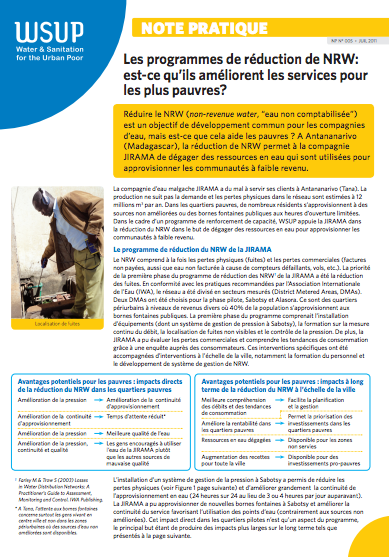
Les programmes de reduction de NRW: est-ce qu’ils ameliorent les services pour les plus pauvres?

Les programmes de reduction de NRW: est-ce qu’ils ameliorent les services pour les plus pauvres?

by Polly Markandya | Jul 15, 2011

Réduire le NRW (non-revenue water, “eau non comptabilisée”) est un objectif de développement commun pour les compagnies d’eau, mais est-ce que cela aide les pauvres ? A Antananarivo (Madagascar), la réduction de NRW permet à la compagnie JIRAMA de dégager des...
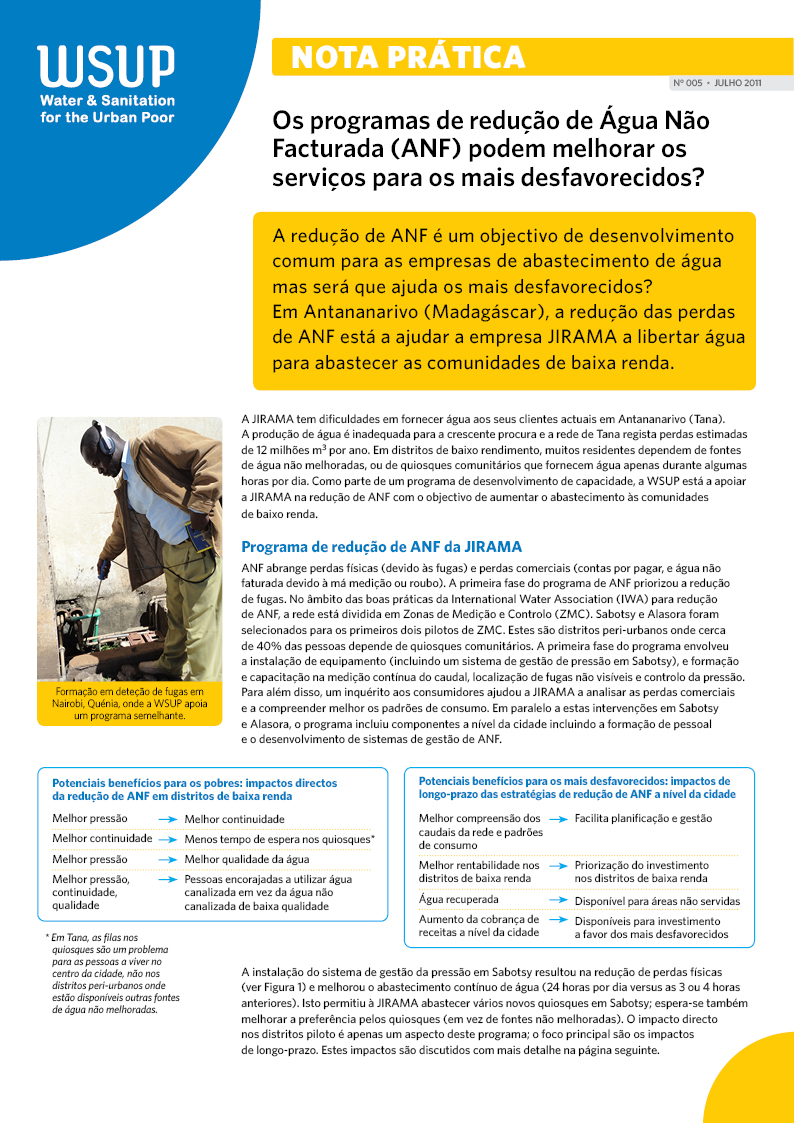
Os programas de redução de água não facturada (anf) podem melhorar os serviços para os mais desfavorecidos?

Os programas de redução de água não facturada (anf) podem melhorar os serviços para os mais desfavorecidos?

by Polly Markandya | Jul 15, 2011

A redução de ANF é um objectivo de desenvolvimento comum para as empresas de abastecimento de água mas será que ajuda os mais desfavorecidos? Em Antananarivo (Madagáscar), a redução das perdas de ANF está a ajudar a empresa JIRAMA a libertar água para abastecer as...
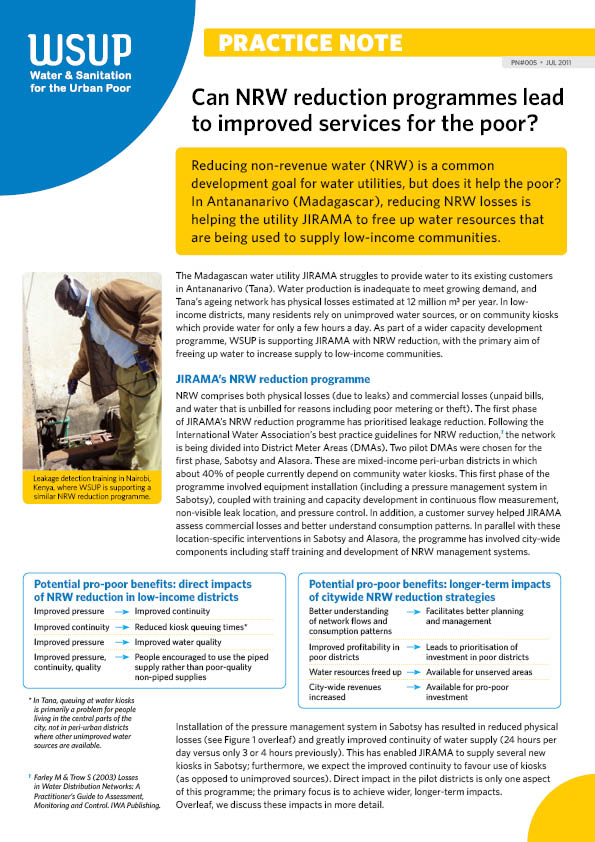
Can improved NRW reduction programmes lead to improved services for the poor?

Can improved NRW reduction programmes lead to improved services for the poor?

by Polly Markandya | Jun 15, 2011

Reducing non-revenue water (NRW) is a common development goal for water utilities, but does it help the poor? In Antananarivo, Madagascar, reducing NRW losses is helping the utility JIRAMA to free up water resources that are being used to supply low-income...
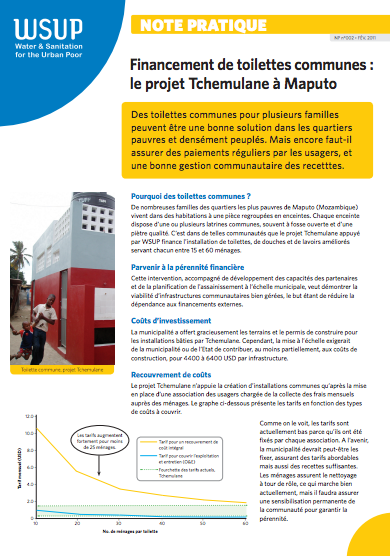
Financement de toilettes communes: le project Tchemulane a Maputo

Financement de toilettes communes: le project Tchemulane a Maputo

by Polly Markandya | Feb 17, 2011

Des toilettes communes pour plusieurs familles peuvent être une bonne solution dans les quartiers pauvres et densément peuplés. Mais encore faut-il assurer des paiements réguliers par les usagers, et une bonne gestion communautaire des recetttes.

Page 8 of 10« First«...678910»

Support our work

Donate now

Newsletter

Sign up to receive updates

Sign up

Tags

2021 africa digital Ghana groundwater Hygiene Kenya partnerships regulation Sanitation sewers smart water technology Water world water day world water week
Sign up for our Newsletter to receive all the latest WSUP news straight to your inbox

International secretariat registered at:

124 City Road, London, EC1V 2NX, UK

Companies House 05419428

WSUP Charity 1170651
  • About us
  • Where we work
  • Partner with us
  • Advisory
  • Media Centre
  • Resources
  • Careers
  • Charity




© WSUP
  • Cookie Policy
  • Privacy Notice
  • Policies
  • Report a Concern