• About us
    • Our Story
    • How we create impact
    • Why WASH matters
      • Health
      • Education
      • Employment and economy
      • Women & girls
      • Climate change
      • Environmental pollution
    • Our team
    • Accountability and financials
      • Governance
      • Financials
    • Contact us
  • Where we work
    • Bangladesh
    • Ghana
    • Kenya
    • Madagascar
    • Mozambique
    • Zambia
    • Uganda
  • Partner with us
  • Resources
    • Latest research
      • Innovative approaches to water & sanitation service delivery
      • Institutional capacity
      • Business development & public-private collaboration
      • Policy, planning & sector reform
      • Regulation
      • Financing
      • Citywide inclusive sanitation
      • Integrating water & sanitation with urban development
      • Climate resilience & water security
      • Hygiene & behaviour change
      • Gender & inclusion
      • Assessing impact
    • Sector functionality framework
    • Utility strengthening framework
    • Academic collaborations
    • WSUP’s Theory of Change
  • Advisory
    • About WSUP Advisory
    • Services
    • Areas of expertise
    • Projects
    • Meet the team
    • Contact Advisory
  • Media Centre
    • Browse all
  • Charity
    • Fundraise for WSUP
    • Pledge your birthday
    • In-memory or celebration
    • Leave a gift in your Will
  • Careers
    • Vacancies
  • About us
    • Our Story
    • How we create impact
    • Why WASH matters
      • Health
      • Education
      • Employment and economy
      • Women & girls
      • Climate change
      • Environmental pollution
    • Our team
    • Accountability and financials
      • Governance
      • Financials
    • Contact us
  • Where we work
    • Bangladesh
    • Ghana
    • Kenya
    • Madagascar
    • Mozambique
    • Zambia
    • Uganda
  • Partner with us
  • Resources
    • Latest research
      • Innovative approaches to water & sanitation service delivery
      • Institutional capacity
      • Business development & public-private collaboration
      • Policy, planning & sector reform
      • Regulation
      • Financing
      • Citywide inclusive sanitation
      • Integrating water & sanitation with urban development
      • Climate resilience & water security
      • Hygiene & behaviour change
      • Gender & inclusion
      • Assessing impact
    • Sector functionality framework
    • Utility strengthening framework
    • Academic collaborations
    • WSUP’s Theory of Change
  • Advisory
    • About WSUP Advisory
    • Services
    • Areas of expertise
    • Projects
    • Meet the team
    • Contact Advisory
  • Media Centre
    • Browse all
  • Charity
    • Fundraise for WSUP
    • Pledge your birthday
    • In-memory or celebration
    • Leave a gift in your Will
  • Careers
    • Vacancies
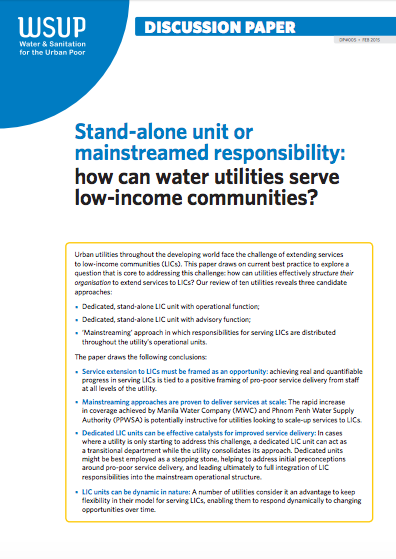
Stand-alone unit or mainstreamed responsibility: how can water utilities serve low-income communities?

Stand-alone unit or mainstreamed responsibility: how can water utilities serve low-income communities?

by Polly Markandya | Feb 17, 2015

Drawing upon 10 case studies from Africa and Asia, this Discussion Paper explores a question that is core to the urban water supply challenge: how can utilities effectively structure their organisation to extend services to low-income communities?
Introducing safe FSM services in low-income areas: lessons from Lusaka

Introducing safe FSM services in low-income areas: lessons from Lusaka

by Polly Markandya | Jan 18, 2015

Despite the acknowledged importance of on-site sanitation, examples of safe and commercially viable faecal sludge management (FSM) services remain few and far between. This Topic Brief sets out the process and learning from a recent project – completed with funding...
FSM Services in Lusaka: moving up the excreta management ladder

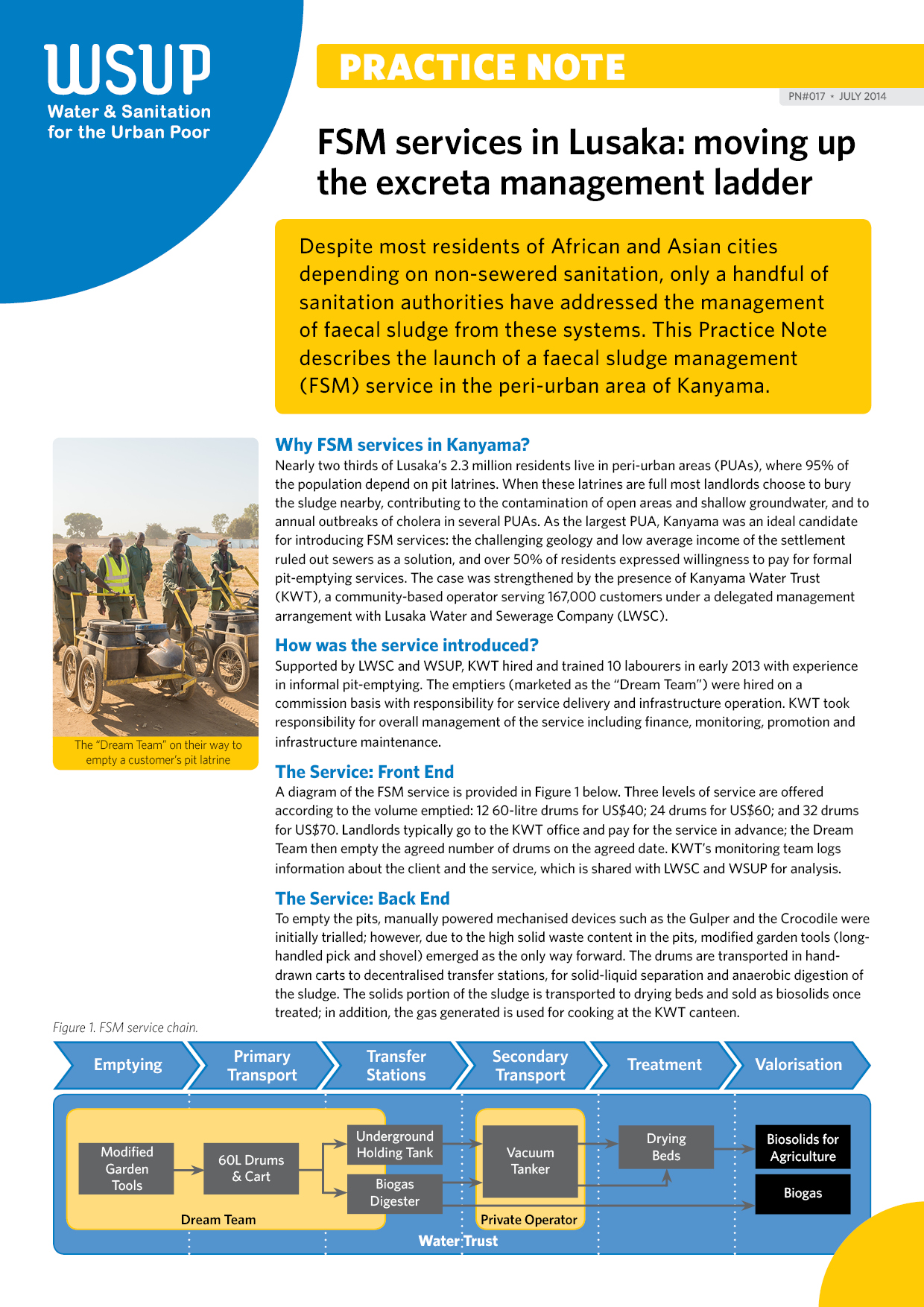
FSM Services in Lusaka: moving up the excreta management ladder

by Polly Markandya | Jul 17, 2014

Despite most residents of African and Asian cities depending on non-sewered sanitation, only a handful of sanitation authorities have addressed the management of faecal sludge from these systems. This Practice Note describes the launch of a faecal sludge management...
Sewerage or FSM? Sometimes both: ‘gradual sewering’ in Nairobi

Sewerage or FSM? Sometimes both: ‘gradual sewering’ in Nairobi

by Polly Markandya | Mar 17, 2014

Nairobi’s super-slum Kibera is criss-crossed by sewer mains. So why not simply connect latrines to the sewer? Unfortunately it’s not so simple, for various reasons including high costs. In partnership with Nairobi Water, WSUP has been developing a ‘gradual sewering’...
Clean Team, a human-centred approach to sanitation: initial trials in Ghana

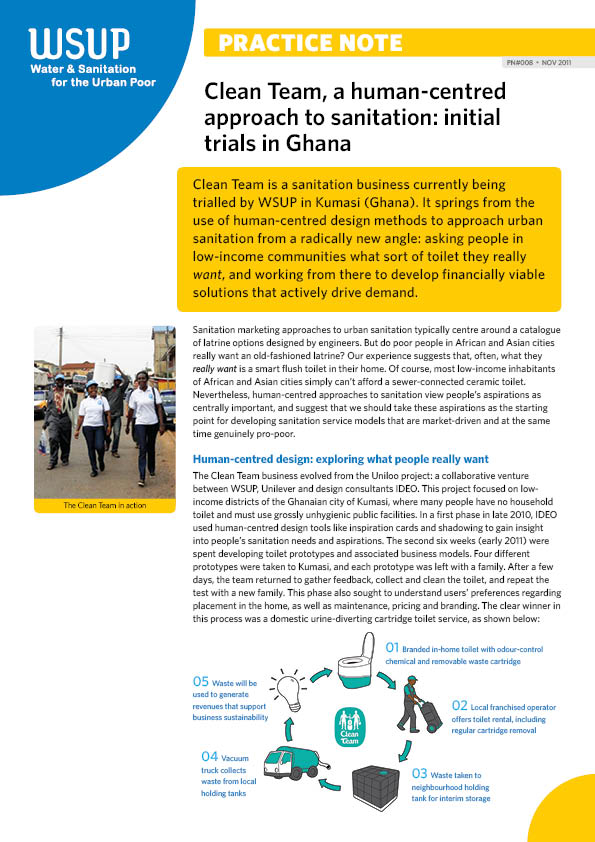
Clean Team, a human-centred approach to sanitation: initial trials in Ghana

by Polly Markandya | Nov 15, 2011

Clean Team is a sanitation business currently being trialled by WSUP in Kumasi (Ghana), in collaboration with Unilever. Using human-centred design methods, it approaches urban sanitation from a radically new angle: asking people in low-income communities what sort of...

Page 7 of 8« First«...45678»

Support our work

Donate now

Newsletter

Sign up to receive updates

Sign up

Tags

2021 africa digital Ghana groundwater Hygiene Kenya partnerships regulation Sanitation sewers smart water technology Water world water day world water week
Sign up for our Newsletter to receive all the latest WSUP news straight to your inbox

International secretariat registered at:

124 City Road, London, EC1V 2NX, UK

Companies House 05419428

WSUP Charity 1170651
  • About us
  • Where we work
  • Partner with us
  • Advisory
  • Media Centre
  • Resources
  • Careers
  • Charity




© WSUP
  • Cookie Policy
  • Privacy Notice
  • Policies
  • Report a Concern