• About us
    • Our Story
    • How we create impact
    • Why WASH matters
      • Health
      • Education
      • Employment and economy
      • Women & girls
      • Climate change
      • Environmental pollution
    • Our team
    • Accountability and financials
      • Governance
      • Financials
    • Contact us
  • Where we work
    • Bangladesh
    • Ghana
    • Kenya
    • Madagascar
    • Mozambique
    • Zambia
    • Uganda
  • Partner with us
  • Resources
    • Latest research
      • Innovative approaches to water & sanitation service delivery
      • Institutional capacity
      • Business development & public-private collaboration
      • Policy, planning & sector reform
      • Regulation
      • Financing
      • Citywide inclusive sanitation
      • Integrating water & sanitation with urban development
      • Climate resilience & water security
      • Hygiene & behaviour change
      • Gender & inclusion
      • Assessing impact
    • Sector functionality framework
    • Utility strengthening framework
    • Academic collaborations
    • WSUP’s Theory of Change
  • Advisory
    • About WSUP Advisory
    • Services
    • Areas of expertise
    • Projects
    • Meet the team
    • Contact Advisory
  • Media Centre
    • Browse all
  • Charity
    • Fundraise for WSUP
    • Pledge your birthday
    • In-memory or celebration
    • Leave a gift in your Will
  • Careers
    • Vacancies
  • About us
    • Our Story
    • How we create impact
    • Why WASH matters
      • Health
      • Education
      • Employment and economy
      • Women & girls
      • Climate change
      • Environmental pollution
    • Our team
    • Accountability and financials
      • Governance
      • Financials
    • Contact us
  • Where we work
    • Bangladesh
    • Ghana
    • Kenya
    • Madagascar
    • Mozambique
    • Zambia
    • Uganda
  • Partner with us
  • Resources
    • Latest research
      • Innovative approaches to water & sanitation service delivery
      • Institutional capacity
      • Business development & public-private collaboration
      • Policy, planning & sector reform
      • Regulation
      • Financing
      • Citywide inclusive sanitation
      • Integrating water & sanitation with urban development
      • Climate resilience & water security
      • Hygiene & behaviour change
      • Gender & inclusion
      • Assessing impact
    • Sector functionality framework
    • Utility strengthening framework
    • Academic collaborations
    • WSUP’s Theory of Change
  • Advisory
    • About WSUP Advisory
    • Services
    • Areas of expertise
    • Projects
    • Meet the team
    • Contact Advisory
  • Media Centre
    • Browse all
  • Charity
    • Fundraise for WSUP
    • Pledge your birthday
    • In-memory or celebration
    • Leave a gift in your Will
  • Careers
    • Vacancies
Sanitation surcharges collected through water bills: a way forward for financing pro-poor sanitation?

Sanitation surcharges collected through water bills: a way forward for financing pro-poor sanitation?

by Polly Markandya | Oct 17, 2012

Market-driven models for sanitation in low-income areas are of unquestionable importance, but there is broad consensus that the market needs to be supported by some sort of public revenue stream. One potentially pro-poor approach to revenue generation, as demonstrated...
Recognising and dealing with informal influences in water and sanitation services delivery

Recognising and dealing with informal influences in water and sanitation services delivery

by Polly Markandya | Jul 15, 2012

Donor-funded water and sanitation improvement programmes operate within the formal frameworks put in place by municipal or national governments. However, in order to plan and implement programmes effectively, it is essential that implementers also recognise and take...
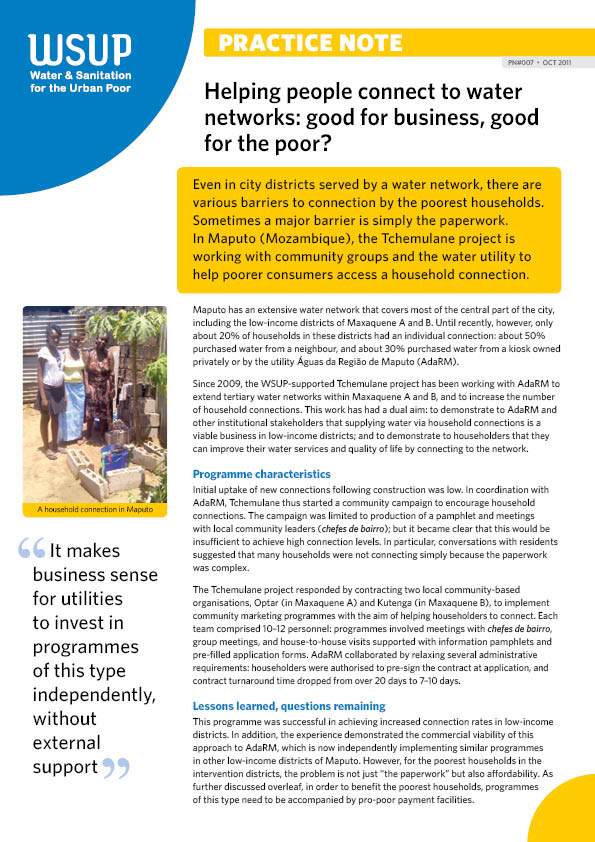
Helping people connect to water networks: good for business, good for the poor?

Helping people connect to water networks: good for business, good for the poor?

by Polly Markandya | Oct 17, 2011

Even in city districts served by a water network, there are various barriers to connection by the poorest households. Sometimes a major barrier is simply the paperwork. In Maputo, Mozambique, the Tchemulane project is working with community groups and the water...
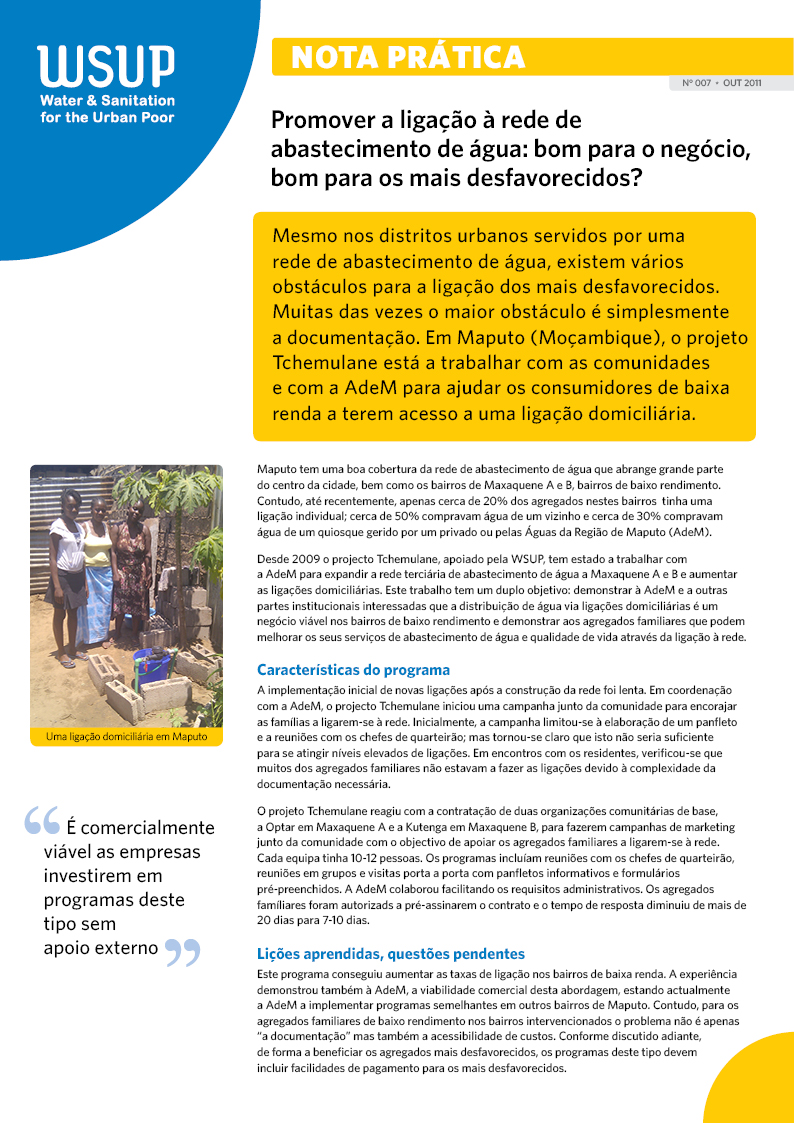
Promover a ligação à rede de abastecimento de água: bom para o negócio, bom para os mais desfavorecidos?

Promover a ligação à rede de abastecimento de água: bom para o negócio, bom para os mais desfavorecidos?

by Polly Markandya | Oct 17, 2011

Mesmo nos distritos urbanos servidos por uma rede de abastecimento de água, existem vários obstáculos para a  ligação dos mais desfavorecidos. Muitas das vezes o maior obstáculo é simplesmente a documentação. Em  Maputo (Moçambique), o projeto Tchemulane está a...
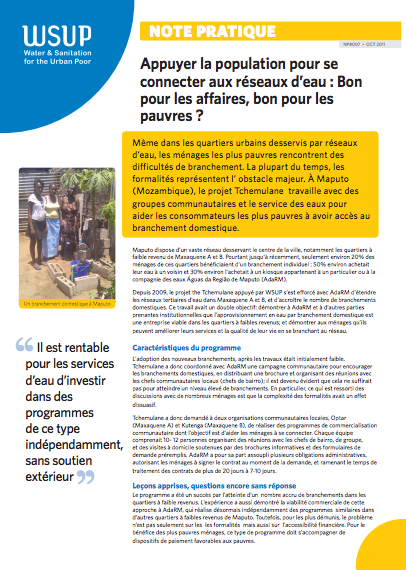
Appuyer la population pour se connecter aux réseaux d’eau : bon pour les affaires, bon pour les pauvres ?

Appuyer la population pour se connecter aux réseaux d’eau : bon pour les affaires, bon pour les pauvres ?

by Polly Markandya | Oct 17, 2011

Même dans les quartiers urbains desservis par réseaux d’eau, les ménages les plus pauvres rencontrent des difficultés de branchement. La plupart du temps, les formalités représentent l’ obstacle majeur. À Maputo (Mozambique), le projet Tchemulane travaille avec des...

Page 20 of 21« First«...10...1718192021»

Support our work

Donate now

Newsletter

Sign up to receive updates

Sign up

Tags

2021 africa digital Ghana groundwater Hygiene Kenya partnerships regulation Sanitation sewers smart water technology Water world water day world water week
Sign up for our Newsletter to receive all the latest WSUP news straight to your inbox

International secretariat registered at:

124 City Road, London, EC1V 2NX, UK

Companies House 05419428

WSUP Charity 1170651
  • About us
  • Where we work
  • Partner with us
  • Advisory
  • Media Centre
  • Resources
  • Careers
  • Charity




© WSUP
  • Cookie Policy
  • Privacy Notice
  • Policies
  • Report a Concern