by Polly Markandya | May 17, 2013
Plans for sanitation improvements often stall at an early stage due to the challenge of costing different sanitation options, leaving low-income communities without improved sanitation. To address this need, WSUP, IWA and local partners have developed a financial tool...
by Polly Markandya | Feb 15, 2013
WSUP’s work takes place in urban contexts with complex formal and informal land ownership arrangements, raising diverse challenges for water and sanitation service provision. For example, the people in most need of improved water and sanitation are often tenants, yet...
by Polly Markandya | Oct 17, 2012
Market-driven models for sanitation in low-income areas are of unquestionable importance, but there is broad consensus that the market needs to be supported by some sort of public revenue stream. One potentially pro-poor approach to revenue generation, as demonstrated...
by Polly Markandya | Nov 15, 2011
Clean Team is a sanitation business currently being trialled by WSUP in Kumasi (Ghana), in collaboration with Unilever. Using human-centred design methods, it approaches urban sanitation from a radically new angle: asking people in low-income communities what sort of...
by Polly Markandya | Feb 17, 2011
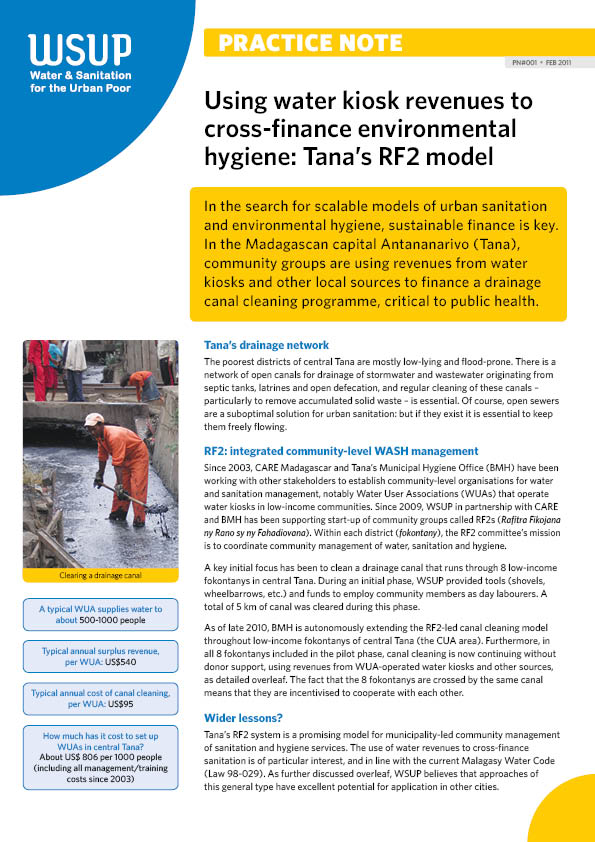
In the Madagascan capital Antananarivo (Tana), community groups are using revenues from water kiosks and other local sources to finance a drainage canal cleaning programme, critical to public health. This practice note argues that the Tana experience may provide a...