by Polly Markandya | Sep 17, 2013
Supporting entrepreneurs to start up viable sanitation businesses can be relatively straightforward. However, challenges typically arise in the transition from donor-supported start-up to true independence. This note looks at the obstacles that need to be overcome in...
by Polly Markandya | Jul 9, 2013
A clear distinction is generally made between community and private management of water and sanitation services. For example, entrepreneurs who provide services are assumed to hold very different motivations, values and approaches to Community Based organisations...
by Polly Markandya | Feb 15, 2013
Extending water and sanitation services to the urban poor will often involve contractual relationships between small-scale entrepreneurs and municipalities or utilities. This Topic Brief draws on WSUP’s experience in the African Cities for the Future (ACF) programme...
by Polly Markandya | Oct 17, 2012
Market-driven models for sanitation in low-income areas are of unquestionable importance, but there is broad consensus that the market needs to be supported by some sort of public revenue stream. One potentially pro-poor approach to revenue generation, as demonstrated...
by Polly Markandya | Nov 15, 2011
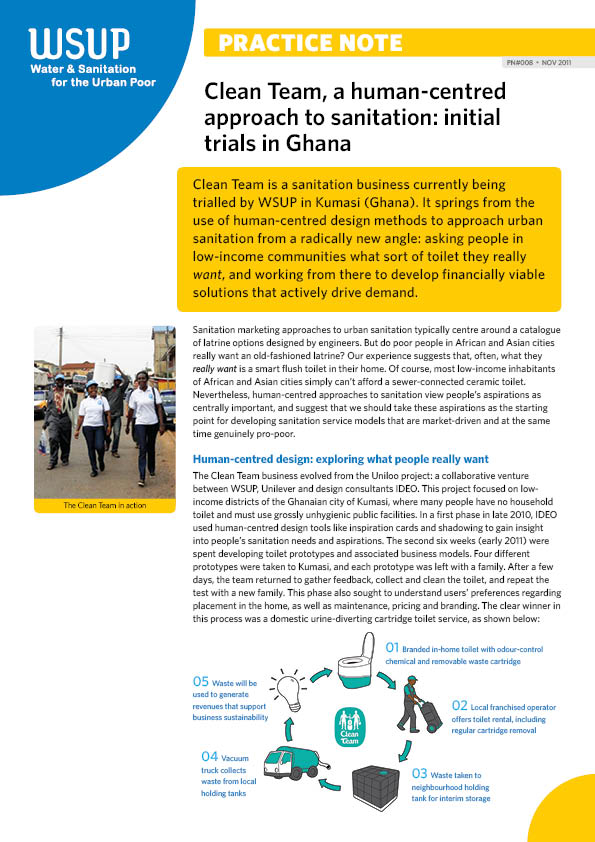
Clean Team is a sanitation business currently being trialled by WSUP in Kumasi (Ghana), in collaboration with Unilever. Using human-centred design methods, it approaches urban sanitation from a radically new angle: asking people in low-income communities what sort of...