

For more than three decades, Joyce Wangui has sold sugar, cooking oil, and mobile phone airtime from a tin-roofed kiosk in the winding alleys of Mukuru Kwa Njenga, one of Nairobi’s most densely packed informal settlements. Her kiosk, weather-beaten but orderly, is the kind of place that neighbours rely on not just for groceries, but for gossip, community news, and the occasional loan in tough times.
But it is not her business acumen or her steady presence in the community that has brought her quiet notoriety in recent months. It is her toilet.
“I used to spend 4,000 shillings a month just to have it emptied,” she says, motioning behind her stall toward a concrete block of rental rooms she owns. “During the rains, it was worse. We had to do it twice a month. The whole compound would flood with sewage.”
Wangui, a mother of five, is a structure owner, a term used in Mukuru for landlords who rent out rooms in congested courtyards where dozens of people often share a single water tap and toilet. Until last year, she, her family, and her tenants relied on a pit latrine that overflowed regularly due to a high-water table and heavy usage. The stench, the expense, and the risk of disease were all part of the daily calculus of survival in an underserved corner of one of Africa’s fastest-growing cities.
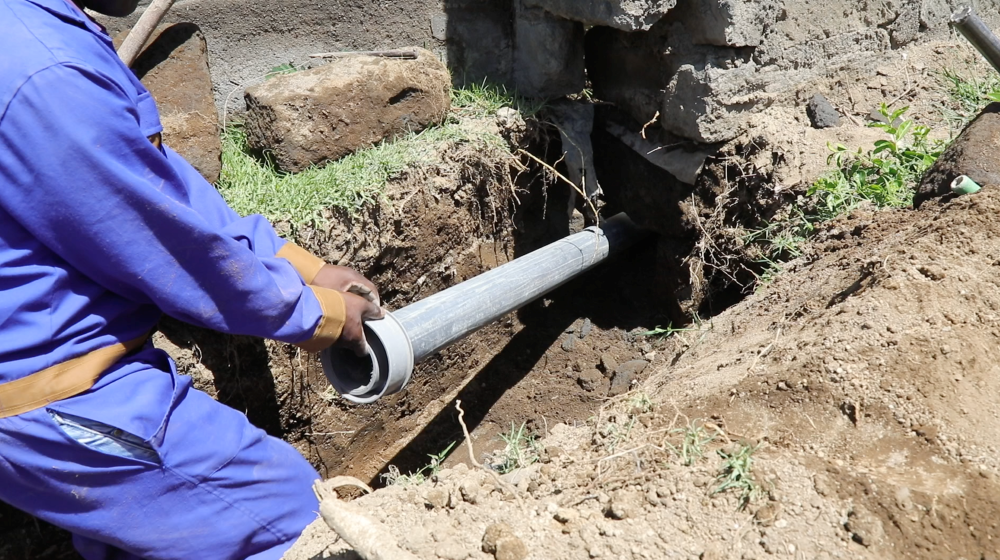
Then came a quiet revolution: a simplified sewer system, introduced by WSUP through a public-private initiative aimed at rethinking how sanitation can work in informal settlements.
A modest fix with big results
Unlike conventional sewers, simplified sewers are designed to navigate the narrow, unplanned alleys of low-income areas. They require less excavation, use smaller pipes, and connect communal or household pour-flush toilets to the city’s main sewer lines. The approach is not new. Brazil and India have deployed similar systems in urban slums, but in Nairobi, it is still novel.
For Wangui, it was life-changing.
Today, the pit latrine has been replaced with a waterborne toilet that connects directly to a functioning sewer line. Her tenants no longer worry about ankle-deep wastewater during storms or the rising cost of pit-emptying trucks. Children can use the toilet without fear of falling in. The entire courtyard smells cleaner, and respiratory and diarrheal illnesses, once common, have sharply declined, she says.
“My tenants don’t want to leave,” she smiles. “They say the clean toilet alone is worth staying.”
An urban challenge hiding in plain sight
Nairobi’s informal settlements are home to more than 60% of the city’s population but occupy just 6% of its land. In Mukuru alone, nearly 300,000 residents are packed into a tangle of tin shacks, exposed wires, and open drains.
Until recently, the government did not formally recognise Mukuru on its urban development maps. That changed in 2017 when the area was declared a Special Planning Area (SPA), unlocking legal pathways to pilot infrastructure upgrades, including roads, water, and sanitation. But progress has been uneven.
“There’s a paradox here,” says a Nairobi-based urban planner familiar with the program. “The technologies exist. The communities are ready. But the financial and policy systems still treat slums as temporary, which holds back investment.”
Indeed, one of the most persistent barriers is recognition. Shared sanitation even improved, sewered versions like Wangui’s are not officially classified as “improved” under international benchmarks such as the Joint Monitoring Programme (JMP), a collaboration between WHO and UNICEF. That means such solutions often do not qualify for government subsidies or donor funding, despite being demonstrably safer and more hygienic than traditional alternatives.
From pit latrines to policy shifts
Recent studies, including the landmark MapSan trial in Mozambique, have shown that high-quality shared sanitation can reduce child stunting by 31%, a bigger health impact than some nutrition interventions. These findings are slowly reframing how experts think about sanitation in low-income urban contexts.
Back in Mukuru, Wangui is less interested in metrics than in peace of mind. “I just want my children and my tenants to live in a clean place,” she says. “We work too hard to be sick from our own toilets.”
Her story, though local and deeply personal, points to a broader question: What if the answer to urban sanitation is not waiting for waterborne toilets for every household, but rather investing in communal infrastructure that is already working?
A call to rethink what is possible
For funders and policymakers, Mukuru offers a test case: Can simplified solutions be scaled up in a way that is cost-effective, community-led, and backed by evidence?
The answer, according to many working in the sector, is yes, but only if investments shift from viewing sanitation as a capital project to seeing it as a long-term service requiring maintenance, monitoring, and social buy-in.
Back at her kiosk, Wangui is hopeful but clear-eyed. “This is better. Much better,” she says, locking up for the day. “But there are still many people here using the old toilets. They are still waiting.”
For now, her upgraded toilet stands as a quiet symbol of what’s possible when innovation meets inclusion and when urban progress is measured not just by new skyscrapers, but by the dignity found in a clean, working toilet.
In neighbourhoods like Mukuru, small-scale infrastructure investments are unlocking major health and economic benefits. As governments and donors re-evaluate how to meet SDG targets by 2030, the time is right to back proven, practical solutions that work, starting with sanitation.